Nature's Secret Recipe: Powering the Future with Solar Fuels
Solar energy technologies limitations
When we think of clean energy, we picture solar panels and electric cars. But photovoltaics and lithium-ion batteries carry hidden costs: critical-material dependence, difficult recycling, and too little energy density for heavy industry, shipping, and aviation — the "hard-to-abate sectors" behind roughly 40% of global CO2 emissions [1]. Today, 97% of maritime and aviation transport still runs on fossil fuels [2].
Observing Nature: the recipe of photosynthesis
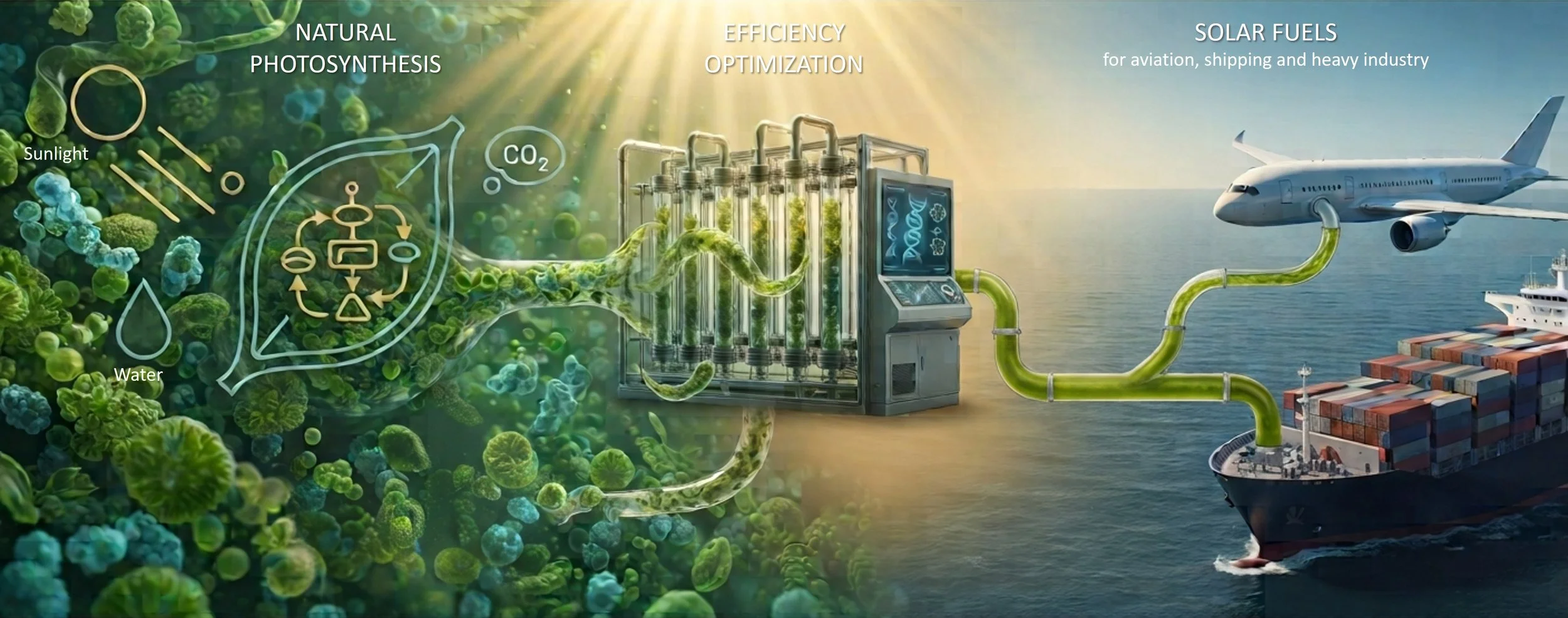
Fortunately, Nature solved energy storage billions of years ago through photosynthesis. Scientists are now working to harness this process using living photosynthetic organisms like microalgae and cyanobacteria to produce liquid solar fuels — such as solar butanol — directly from sunlight and air. Converting inputs directly within living cells avoids agricultural land competition inherent to traditional biofuels and bypasses the massive grid demands of e-fuels, yielding drop-in fuels fully compatible with existing engines and pipelines.
Nature evolved for survival, not productivity
Yet, despite centuries of study, we still know remarkably little about how natural photosynthesis operates at its most fundamental level. Because living organisms evolved for biological survival rather than mass fuel output, natural conversion efficiency remains below 1%. Closing that gap requires two parallel efforts: first, unravelling the basic physical, chemical, and biological mechanisms of light capture, and second, re-engineering these pathways for industrial efficiency. Simply put, we cannot successfully reroute cellular machinery if we do not yet fully understand how it works.
Fundamental research today, sustainable future tomorrow
This research sits at early Technology Readiness Levels (TRL 2 to 4), a horizon private capital rarely funds since commercial competitiveness remains years away. Under the European Green Deal and its 'Fit for 55' package, the EU introduced the ReFuelEU Aviation and FuelEU Maritime regulations to enforce a shift toward sustainable fuels. Horizon Europe initiatives, such as SUNER-C, S2B, Photo2Fuel and SUN-PERFORM, pair researchers across a dozen countries, pushing efficiency further than any single lab could alone.
Yet, consortia alone won't close a decades-long knowledge gap, and mandates only work if research policy matches their ambition. Nature never optimized photosynthesis for fuel output: we still have to decode the mechanism before we can rewrite it, which demands funding that survives election cycles, plus a public that understands why TRL-2 science deserves support long before reaching market. Without that awareness, foundational research risks being sidelined for shallower fixes — leaving Nature's recipe half-read just when we need to rewrite it most.
[2] https://www.iea.org/reports/renewables-2025/renewable-transport