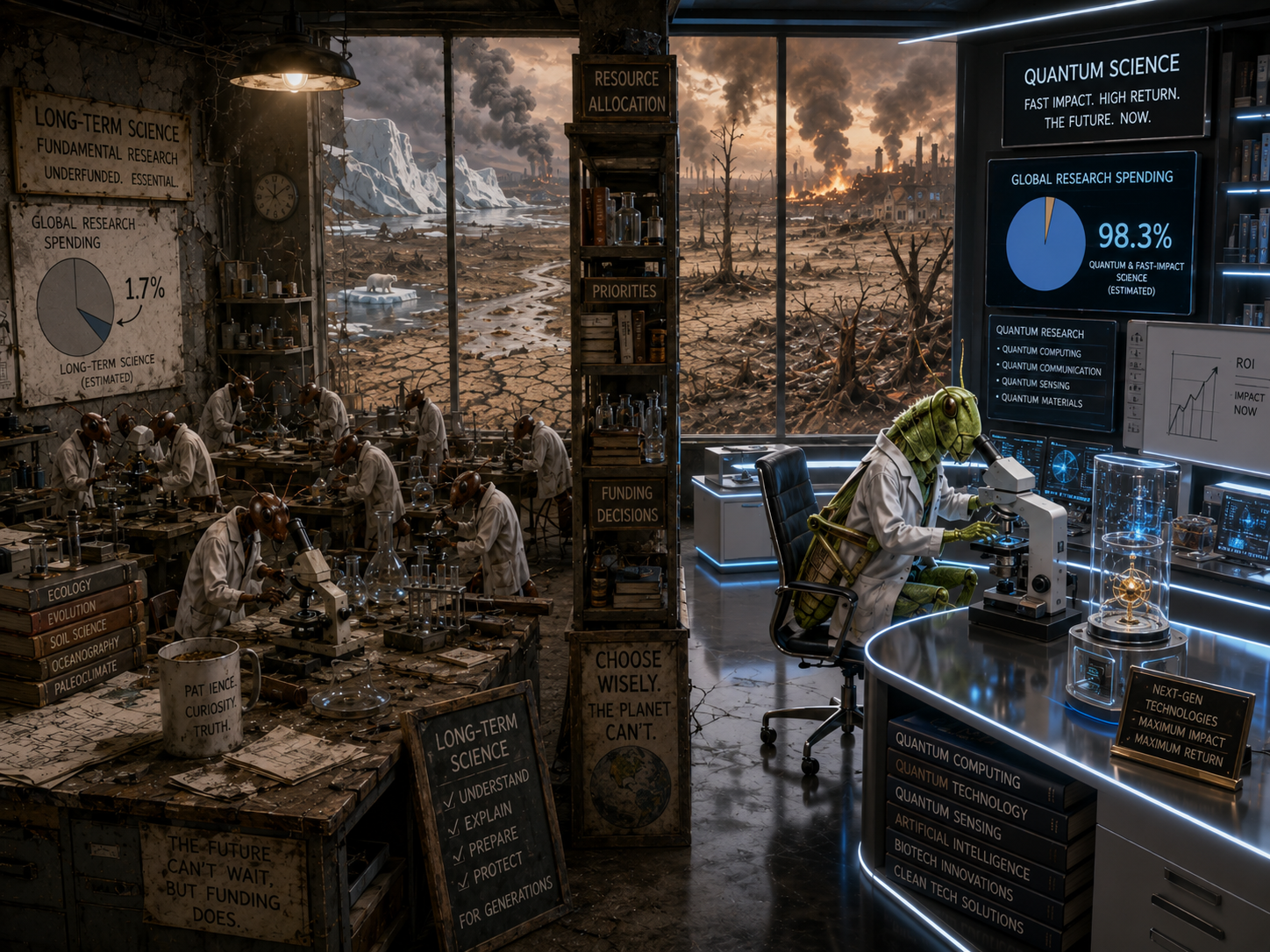
Ants not Grasshoppers: Climate Change Calls for Long-term Science
Oceans, Carbon Cycling, and Climate Regulation
Oceans cover 70% of Earth’s surface, contain approximately 97% of the planet’s water, produce about 50% of the atmospheric oxygen and absorb huge quantities of carbon dioxide playing a key role in regulating Earth’s climate. Central to this regulation is the biological carbon pump. This biogeochemical process begins with microscopic photosynthetic organisms, the phytoplankton, transforming atmospheric carbon dioxide into biomass through photosynthesis. It continues via aggregation of organic carbon into particles and ends via the sinking of particles in the deep ocean, where carbon can be sequestered for centuries or longer.
Microbial Control of the Biological Carbon Pump
Living invisible bacteria govern the biological carbon pump dynamics. They regulate phytoplankton ecology via symbiotic exchange of metabolites essential for life. Through complex chemosensors, bacteria can find carbon particles, colonize them and metabolize their carbon-rich content, respiring CO₂ and counteracting net carbon capture. Understanding all such microbial processes requires coordinated, multidisciplinary efforts supported by advanced and expensive technologies such as high-resolution microscopy and microfluidics. To date, microbial processes remain a major source of uncertainty in current climate models.
Science Diplomacy Could be Key to Enhance Visibility and Impact of Ocean Science Research
Despite the existence of the UNESCO Decade of Ocean Science for Sustainable Development plan emphasizing the importance of understanding ocean role in climate and human development, public and political awareness of ocean science is extremely limited. UNESCO reports indicate that ocean science receives only around 1.7% of national research budgets [1]. Current ocean climate observations are either short-term or insufficient [2] due to unpredictable funding streams under the annual cycle of government appropriations [3]. Fundings tend to favour fashionable topics, short-term innovation, public appealing and commercially viable sciences. However, addressing future planetary-scale challenges requires sustained, long-term investment in fundamental and strategic research.
Countries such as Peru (11.6%) and South Africa (5.6%) provide valuable examples, yet such efforts remain only a drop in the ocean compared with the scale of the challenges ahead. On going climate change drives ocean warming, acidification, deoxygenation, and ecosystem shifts that may alter microbial activity and consequentially reshape global carbon dynamics, ultimately impacting lives. Science diplomacy may help challenge existing funding biases by translating complex ocean-climate processes into accessible narratives for non-specialists, fostering curiosity, leveraging dissemination activities and third-party networks, and, importantly, transforming current short-term, fast-feedback, grasshopper science into ant, strategically planned, science suited for long-term impact research!
References:
[1] https://www.unesco.org/en/decades/ocean-decade
[2] https://gosr.ioc-unesco.org/files/GOSR2020_IOC-UNESCO_ES_EN.pdf
[3] https://www.nationalacademies.org/projects/DELS-OSB-15-02