Decisions in the Dark: Microbial Behavior and the Governance Gap in Our Oceans
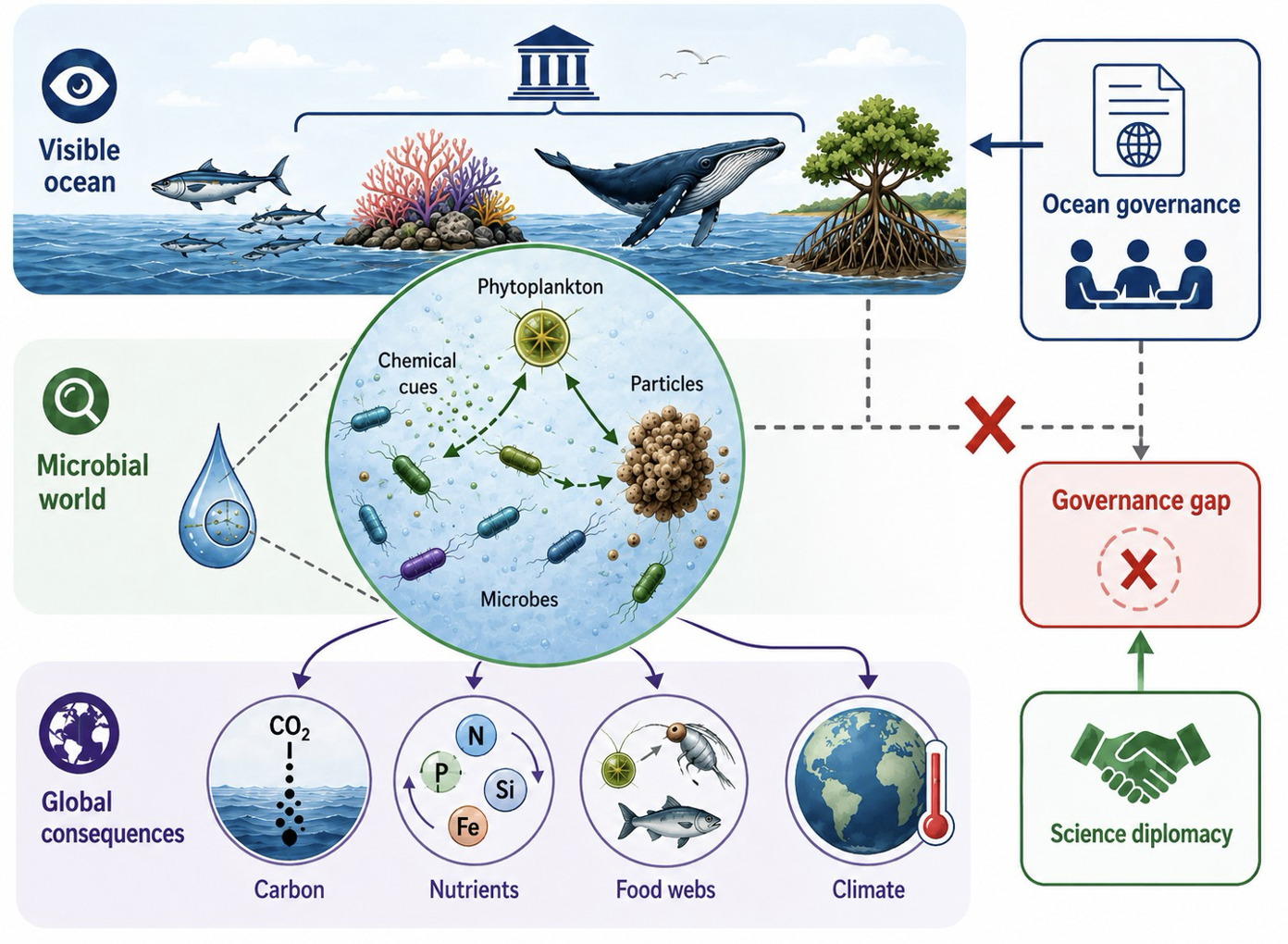
Marine microbes: the ocean’s secret decision-makers
The ocean is often governed through what we can see: fish stocks, coral reefs, whales, mangroves, and coastlines. Yet the ocean’s most abundant and influential life forms are mostly invisible. Beneath every wave, in every drop of seawater, billions of microbial cells sense chemical signals, move, interact, and transform matter in ways that collectively regulate the carbon we breathe, the fish we eat, and the climate we depend on.
The ocean’s hidden majority
Marine microbes - including bacteria, archaea, viruses, protists, and microscopic algae - span from the surface ocean to the deepest waters, with different shapes, sizes, lifestyles, and habitats. Most marine microbes are not passive entities that drift in seawater but actively navigate the water column by detecting chemical signals and swimming toward nutrient-rich hotspots, such as phytoplankton cells, sinking particles, and dissolved organic matter. In a way, they follow chemical scents through the ocean, much like we might follow the smell of fresh bread from our favorite bakery through the city.
Small decisions, planetary consequences
These small decisions matter. When microbes find and consume organic matter or interact with one another, they influence whether carbon is recycled near the surface or transported to the deep ocean. Therefore, their behavior affects processes that are central to climate regulation and ocean health. Every breath of oxygen, every fish, every climate model depends on these processes working right, whether we see it with our eyes or not. These microorganisms and the communities they form also drive and respond to anthropogenic changes in the environment, including climate change-associated changes in temperature, carbon chemistry, nutrient and oxygen content, and alterations in ocean stratification and currents.
A governance gap beneath the surface
International ocean governance has made great progress, from the United Nations Convention on the Law of the Sea (UNCLOS) to the London Convention (LC) and the London Protocol (LP), which address marine pollution and activities such as ocean fertilization. However, these frameworks rarely make microbial life explicit. This creates a governance gap: the organisms that mediate many ocean biogeochemical processes are often absent from the language of the policies designed to protect those same processes. The example of ocean fertilization illustrates this clearly: the addition of nutrients such as iron to surface waters aims to stimulate plankton growth and enhance carbon export, yet the outcome depends on microbial interactions, bacterial degradation, nutrient recycling, and the fate of organic matter. However, the regulatory framework governing it is written as if those microbes do not exist, which risks misunderstanding the effectiveness and ecological consequences of such interventions.
Bringing microbes into science diplomacy
The recently enforced Biodiversity Beyond National Jurisdiction Agreement (BBNJ) offers an important step forward; it is the first international treaty naming and acknowledging marine microbes. Yet microbial life is still mostly treated through the lens of resources, access, and benefit-sharing, rather than as a living system that helps regulate ocean function. Microbial processes still need a stronger voice in how ocean impacts are assessed. This is not necessarily a call for a new treaty. It is a call for microbial oceanography to be better translated into policy advice, environmental assessments, and diplomatic negotiations. Microbes have been running the ocean long before we started governing it. Science diplomacy can help ensure that ocean governance finally sees them.
Special thanks to Dr. Johannes Keegstra for the scientific revision of the article.
References:
[1] International Maritime Organization website. Available from: https://www.imo.org.
[2] United Nations, Agreement on Marine Biological Diversity of Areas beyond National Jurisdiction, BBNJ. Available form: https://www.un.org/bbnjagreement/en.
[3] Tara Ocean Foundation (2022). Priorities for ocean microbiome research. Nature Microbiology, 7(7), 937-947. Available from: https://www.nature.com/articles/s41564-022-01145-5.
[4] Zhang, Z., Zhang, Q., Chen, B., Yu, Y., Wang, T., Xu, N., ... & Qian, H. (2024). Global biogeography of microbes driving ocean ecological status under climate change. Nature Communications, 15(1), 4657. Available from: https://www.nature.com/articles/s41467-024-49124-0.