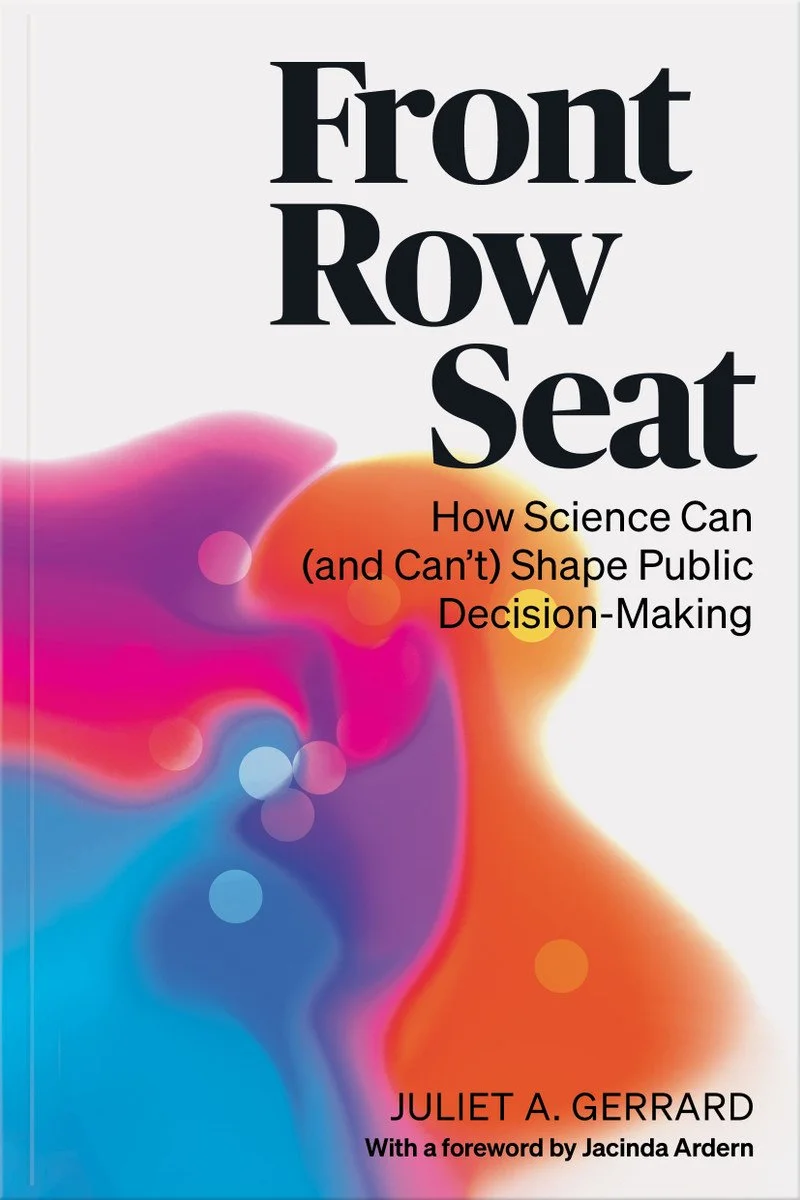
From 2018-2024, I had the privilege of serving as the Chief Science Advisor to the Prime Minister of New Zealand. This spanned three Prime Ministers: Jacinda Ardern for the bulk of my tenure, then Chris Hipkins and Christopher Luxon. On my return to academic life, the University of Auckland generously gave me a year of research and study leave, during which I reflected on what I had learned during those action-packed years, and how I might distill out some useful lessons for others embarking on the tricky business of making their research ‘policy-ready’ and available to decision makers. The result was ‘Front Row Seat’, published by Auckland University Press (Front Row Seat), with an international edition to follow, published by Palgrave.
In the book, I use a series of case studies to inform an analysis of what did and didn’t work as we set about bridging the evidence-policy interface. From these, I drew out three tools for anyone interested in the science-policy interface:
The RITA principles, Rigour, Inclusivity, Transparency and Accessibility: Building on the work of Donnelly et al (see: Four principles to make evidence synthesis more useful for policy | Nature) I explore how RITA might guide the framing and execution of making evidence ready for policymakers.
The consensus quadrant: Understanding the role of consensus in science and the impact of values on decision making are vital. These ideas are distilled into a simple tool – the consensus quadrant – to support the framing of conversations between researchers and policymakers (see: Evidence based policy is not only about the evidence)
A set of 15 questions to help frame conversations between researchers and policy makers: These cover the basics of whether science can help, what counts as evidence, and how a problem might be framed, as well as practical tips about whether and when to make recommendations and how to make the evidence useful even when advice is ignored.
So many of the challenges and opportunities that we currently face are global in scope and require scientific input to address. Science diplomacy plays a vital role in creating pathways forward beyond national borders and interests. I hope that these three tools equip more scientists, policymakers, and diplomats around the world to reach across what divides us and strengthen the connections between countries and ways of knowing.